- Address: 222417, Minskaya oblast., Vileica, Partizanskaya str. 40
- Working hours: 8.30-17.30 lunch 13.00-14.00 (reception of applications from citizens and legal entities - from 8:00)
Humans appeared in the territory of Vileyka District in the 9th millennium BC. Archaeological monuments of the Mesolithic era (Middle Stone Age; 7th–5th millennia BC) — sites where flint tools were found — were discovered near the villages of Ostashkovo and Sosanka. Near the villages of Kameno, Kostyki, Kurenets, Naroch, Rabun and others, monuments of the 4th–2nd millennia BC (Neolithic era) have been identified. In the northern part of the modern district lived tribes of the Kunda culture, which at the beginning of the 4th millennium BC were replaced by tribes of the Narva culture, and in the 3rd millennium BC by the Comb-Pit Ware culture. Near the villages of Volkalatka, Vyazyn, Kostyki, Kurenets, Litvinki, Ostashkovo, Rabun and others, polished axes and other tools dating to the Bronze Age (3rd–2nd millennia BC–7th century BC) and belonging to tribes of the Corded Ware culture were found. Monuments of the Early Iron Age testify to the settlement of the district by Baltic tribes of the Stroke-Ornamented Ware culture. At hillforts and settlements near the villages of Arpa, Bezvodnoye, Borovoye, Galinovo, Dolginovo, Malyshki, as well as near Vileyka, remains of above-ground dwellings of pillar construction and traces of iron production have been identified. Iron sickles, awls, knives, spears, rings, fibulae, bracelets and hand-made pottery were found here. Studies of the settlements of Dolginovo, Sosanka, and Gurki indicate that in the middle of the 1st millennium BC the Stroke-Ornamented Ware culture was replaced by the Bantserovka culture. The burial monuments of the Slavic Krivich-Dregovich population are kurgan burial grounds of the 8th–11th centuries near the villages of Galinovo, Zhurikhi, Kameno, Zaborye and others. The district has more than 20 kurgan burial grounds of the 9th–12th centuries.
In the 10th–13th centuries the territory of the district was part of the Principality of Polotsk; from the 14th century — part of the Grand Duchy of Lithuania.
The earliest mention of Vileyka discovered in written sources dates to 1460.
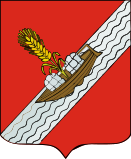
In 1793, after the second partition of the Polish-Lithuanian Commonwealth, the territory of the district — part of the Russian Empire. On May 14, 1795, Vileyka received the status of a city — the center of Vileyka Uyezd of Minsk Governorate; on February 2, 1796, the coat of arms of the uyezd town was approved. From 1842 to 1917, Vileyka Uyezd was part of Vileyka Governorate.
From the 18th century, a glass manufactory operated in Ilya — one of the largest in Belarus. Near Dolginovo, a cloth factory operated in 1823–67.
In World War I, during the elimination of the Sventsyany breakthrough on September 22–23, 1915, the Vileyka offensive operation of Russian troops was carried out. In December 1917, Soviet power was established in the territory of the district. In February–December 1918, the district was occupied by German troops, in July 1919–July and from September 1920 — by Polish troops, in 1921–1939 — as part of the Polish state.
In 1939, Vileyka District became part of the BSSR. From December 4, 1939, Vileyka — the center of the oblast until September 1944, then part of Molodechno, and from January 1960 — of Minsk Oblast.
During the Great Patriotic War, from June 25, 1941 to July 2, 1944, the district was occupied by German-fascist invaders, who destroyed more than 15 thousand civilians and burned 5 villages together with their population; the villages of Lyubcha and Borki of Khotenchitsy Village Council were not restored after the war.
The Vileyka anti-fascist underground resisted the occupiers from July 1941. The Vileyka underground oblast committee of the party and Komsomol, the Ilya and Kurenets underground district committees of the party and Komsomol, the Vileyka partisan formation, and separate partisan detachments and brigades operated. The situation at the fronts and in the enemy rear was covered by the underground newspapers “Partisan Truth”, “Peasant Newspaper”, “People’s Avenger”, “Youth Newspaper”, etc.
On July 5, 1946, Kurenets District was renamed Vileyka District; on July 20, 1957, Ilya District was abolished; on December 25, 1962, part of Krivichi District was annexed to Vileyka District — this completed the territorial-administrative organization of the district.